
Help / MCP
Connect a coding agent through MCP
The DiscountRunners MCP server lets a coding agent such as Claude choose runner classes, price jobs and read your account's jobs and usage, so it can right-size your CI with real measurements. It is separate from running an agent session on a DiscountRunners VM.
Install
Claude Code
The quickest route is the DiscountRunners plugin, which adds the server and its skills in one step. To add only the server:
claude mcp add --transport http discountrunners https://mcp.discountrunners.io/mcpThen run /mcp inside Claude Code, choose discountrunners and authenticate. Your browser opens the DiscountRunners consent page.
Claude on the web and desktop
Add a custom connector in Claude's connector settings with the URL https://mcp.discountrunners.io/mcp, then connect it; the same consent page opens.
Other MCP clients
Any client with Streamable HTTP and OAuth support can use the same endpoint. A client without sign-in can use the public tools alone at https://mcp.discountrunners.io/public/mcp.
Approve the connection
The consent page names the app that is asking and the account it will reach. Only the account itself or an owner of the organization on GitHub can approve. Read access is always included. Tick the extra box to also allow changes to monitors; leave it clear for a read-only connection.
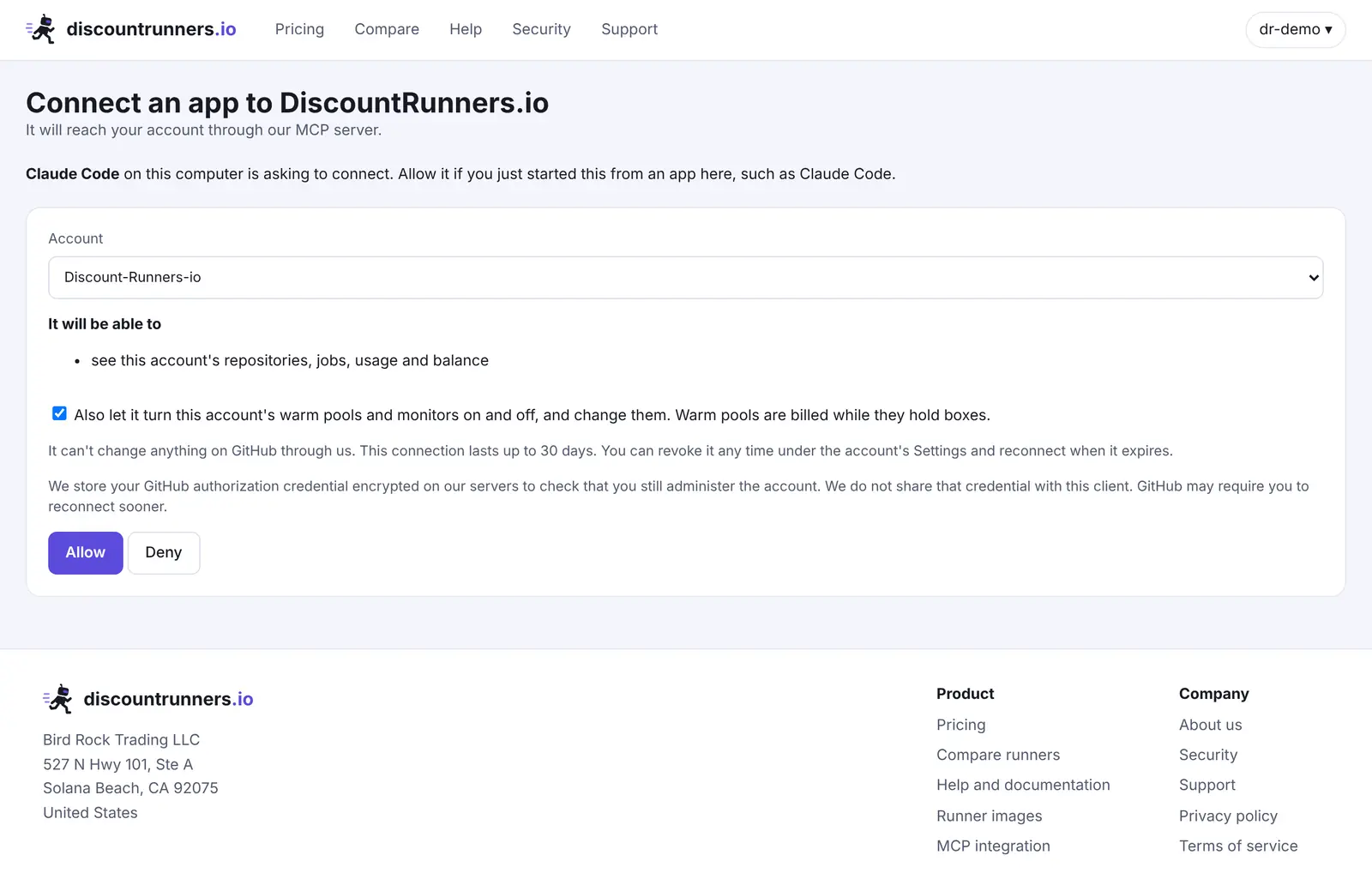
The server changes nothing on GitHub except a re-run of a failed run's failed jobs, and only for a connection you allowed to re-run. A coding agent edits workflows, sets variables and opens pull requests with its own, separately authorized GitHub connection. Only runs-on values, labels, and variable names and values reach our server; workflow files, code and logs stay on your machine.
Tools
Public tools, no sign-in
| Tool | What it does |
|---|---|
list_runner_classes | Every DiscountRunners runner class with its size, image, architecture, regions, price per minute, physical cores and GitHub-hosted price at the same core count. |
quote | What a job of a given duration costs on one of our classes, against a competitor at the same number of physical cores (GitHub-hosted by default), each under its own billing rule. |
map_labels | The DiscountRunners class for a job's runs-on value. For a ${{ }} expression, which quoted labels can move, to which class, and which variables still name an old label. |
check_rewrite | Whether an edited runs-on value changes only runner labels, each to its planned class. Check every edited line before committing it. |
Account tools, read access
| Tool | What it does |
|---|---|
list_repositories | The signed-in account's repositories: jobs, minutes and spend on DiscountRunners, and how many workflow jobs still run on another provider's runners. |
runner_choices | For one repository, the runner labels each workflow job last asked for, ours or anyone's, and whether it recently switched. |
job_history | Recent runs of a repository's jobs on DiscountRunners: class, queue wait, run time, cost, CPU and memory p95, and whether a smaller class would have fit. |
workflow_profile | Per workflow job and class: runs, failures, p50 and p95 run time, p95 queue wait, CPU and memory use, spend and cost per run. Start right-sizing here. |
recommend | For one repository: jobs to downsize or upsize, jobs on an older runner name to move to its published size, jobs a warm pool would start sooner, and jobs still running elsewhere that could move here, each with why and how. |
explain_job | Why a job waited, failed over or ran where it did, in the dashboard's words. |
account_status | Balance, holds, this month's spend, caps, concurrency limit and warm pools. |
list_jobs | The account's jobs on our runners across every repository, newest first: state, runner class, queue, boot and run time, billed minutes and charge. Page with cursor. |
get_job | One job with its VMs, its timeline from queued to finished, and what it was charged. |
get_job_network | What the network itself logged for one job's VM, outside the VM: each address, port and host it talked to, bytes each way, blocked attempts, and whether the VM's own report left any out. |
list_runs | The account's workflow runs that used our runners, newest first, each with its job count, state, run time and charge. Page with cursor. |
get_run | One attempt of a workflow run with each of its jobs on our runners. |
usage | What the account was charged in a month, by product, repository, day and runner class, with billed minutes. |
list_ledger | The account's balance, any discount on its runner time, and its ledger entries (top-ups, charges, refunds, credits), newest first, each with the balance after it and what a discount took off it. |
list_monitors | The account's job monitors (failure and slow-job alerts) and their recent events. |
diagnose_run | Where one workflow run's time went: every job on one time axis, the chain of jobs that set its end time, each job's steps, runner waits, runner minutes and charges. Use for 'why was this run slow'. |
diagnose_job | One job's steps, which step failed, the log lines around its first error, and how the same job ended in earlier runs. Use for 'why did this job fail'. |
plan_parallel | Where a workflow's recent successful runs could run in parallel: a matrix that shards a job's longest step, a long job split into jobs on separate runners, or a needs: wait that may not be needed. Each comes with the run time before and after and the runner minutes it adds. |
analyze | The last days of an account's or one repository's workflow runs: runs and success rate by day, runner minutes on each provider, what we charged and what the same jobs would have cost elsewhere, the slowest workflows and jobs, and the jobs that failed most. Defaults to 7 days. |
rerun_status | Whether a re-run asked for with rerun_failed_jobs was made, and why not if it wasn't. |
get_account_settings | The account's settings: job-log costs, re-runs, package mirrors, credit emails, pull-request comments, controls, SSH, network and the history import. |
list_storage | The account's cache entries, sticky disk snapshots or repository images, largest first, with their ids. |
get_telemetry_export | Where the account's job traces, metrics and logs are sent over OpenTelemetry, which headers are set (names only), and how the last send went. |
Account tools that change something
Offered only when you ticked the box to allow changes.
| Tool | What it does |
|---|---|
set_monitor | Creates a failure or slow-job monitor or changes one; fields left out keep their values. Slack alerts can reuse a webhook another monitor of the account already has. |
delete_monitor | Deletes a monitor and its event history. |
record_variable_change | Records a GitHub Actions variable you changed with the user's rights (gh variable set or delete), with the value it held before, in the account's audit log. Variables have no git history, so call it right after every variable change; it changes nothing on GitHub. |
rerun_failed_jobs | Re-runs the failed and cancelled jobs of a finished workflow run, with their dependents, as GitHub's Re-run failed jobs does. The request is made within a minute; rerun_status reports how it went. |
set_account_settings | Turns job-log costs, automatic re-runs and the package mirrors on or off, and sets who gets credit emails; fields left out keep their values. |
set_pr_cost_comments | Whether a repository's pull requests get a comment with their runner cost and saving. |
set_repository_connection | Stops new jobs from one repository running on our runners, or lets them run again. Jobs already running finish; queued ones are cancelled. History and billing stay. |
test_monitor | Sends a test message to the monitor's Slack and email, at most once a minute. |
request_runner_class | Asks us to turn on a runner class this account can't use yet. |
change_history_import | Imports the account's GitHub Actions history from a day up to 400 days back, or pauses or resumes it. |
Workflow, job and branch names in results come from your repositories, where anyone who can open a pull request can write them. Results mark those values as names only, and the skills never treat them as instructions.
Useful requests
- “Which runner matches this workflow's architecture and memory needs, and what would a 6-minute run cost?”
- “Profile this repository's jobs and tell me which are oversized.”
- “Why did job 123456789 wait four minutes before it started?”
- “Move this repository's jobs to DiscountRunners and open a pull request.” The optimize-my-ci skill does this end to end.
Revoke or renew access
Connections are listed under Settings → App connections, with who connected them and when they were last used, and can be revoked there. Consent expires no later than 30 days after approval; reconnect when it expires. Losing administration of the account on GitHub also removes access. The privacy policy explains stored authorization records and the information sent to clients.
Screenshots and videos in Help are a demonstration rebuilt from our own benchmark jobs. The jobs, steps, run times and charges are real; queue waits and the CPU, memory, disk and network graphs in them are illustrative, not measurements.